Platinum Award
Project: Sound Transit Central Link Light Rail Section 710 Beacon Hill Station and Tunnels
Client: Central Puget Sound Regional Transit Authority (Sound Transit)
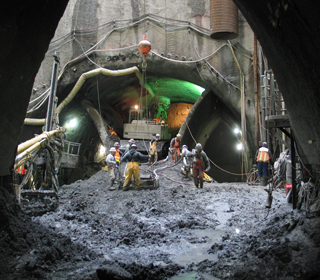
Photo courtesy of HMMJ The Beacon Hill light-rail tunnels needed to be deep to avoid disrupting businesses and traffic above. Unstable soils added to the project’s difficulty.
|
HMMJ’s challenge: Build a deep-mined transit station and a mile of twin rapid-transit tunnels under Beacon Hill as part of the region’s new light-rail system.
The tunnel needed to be deep to avoid disrupting businesses and traffic on the surface, plus it would involve construction in extremely unstable soils. The station was designed with two shafts, a transverse two-level concourse tunnel and two platform tunnels.
HMMJ, working with the Dr. G. Sauer Corp., employed a risk-based design approach in which the design team planned the complete excavation, including the initial and final support systems for the large-diameter shafts and deep tunnels. The team used the Sequential Excavation Method (SEM) to manage the multiple soil challenges.
This approach to deep, complex tunneling in poor soils, at a depth and a diameter close to twice that previously done, resulted in the largest soft-ground SEM tunnel in North America.
Despite the soils, the tunnels were completed with virtually no ground settlement or disruption above. Also, the design reduced the amounts of construction materials used.
“It is probably the most challenging construction project along the whole Link light-rail line,” according to Metropolitan King County Councilmember Larry Phillips. “The methods used to mine out this station have never been used at this depth. We are standing here in an engineering and construction marvel that will be known through the world.”